
LAUNCH SALE UP TO 50% OFFFREE U.S. SHIPPINGCONDUCTIVE GEL IN EVERY BOX30-DAY MONEY-BACK GUARANTEELAUNCH SALE UP TO 50% OFFFREE U.S. SHIPPINGCONDUCTIVE GEL IN EVERY BOX30-DAY MONEY-BACK GUARANTEELAUNCH SALE UP TO 50% OFFFREE U.S. SHIPPINGCONDUCTIVE GEL IN EVERY BOX30-DAY MONEY-BACK GUARANTEELAUNCH SALE UP TO 50% OFFFREE U.S. SHIPPINGCONDUCTIVE GEL IN EVERY BOX30-DAY MONEY-BACK GUARANTEE
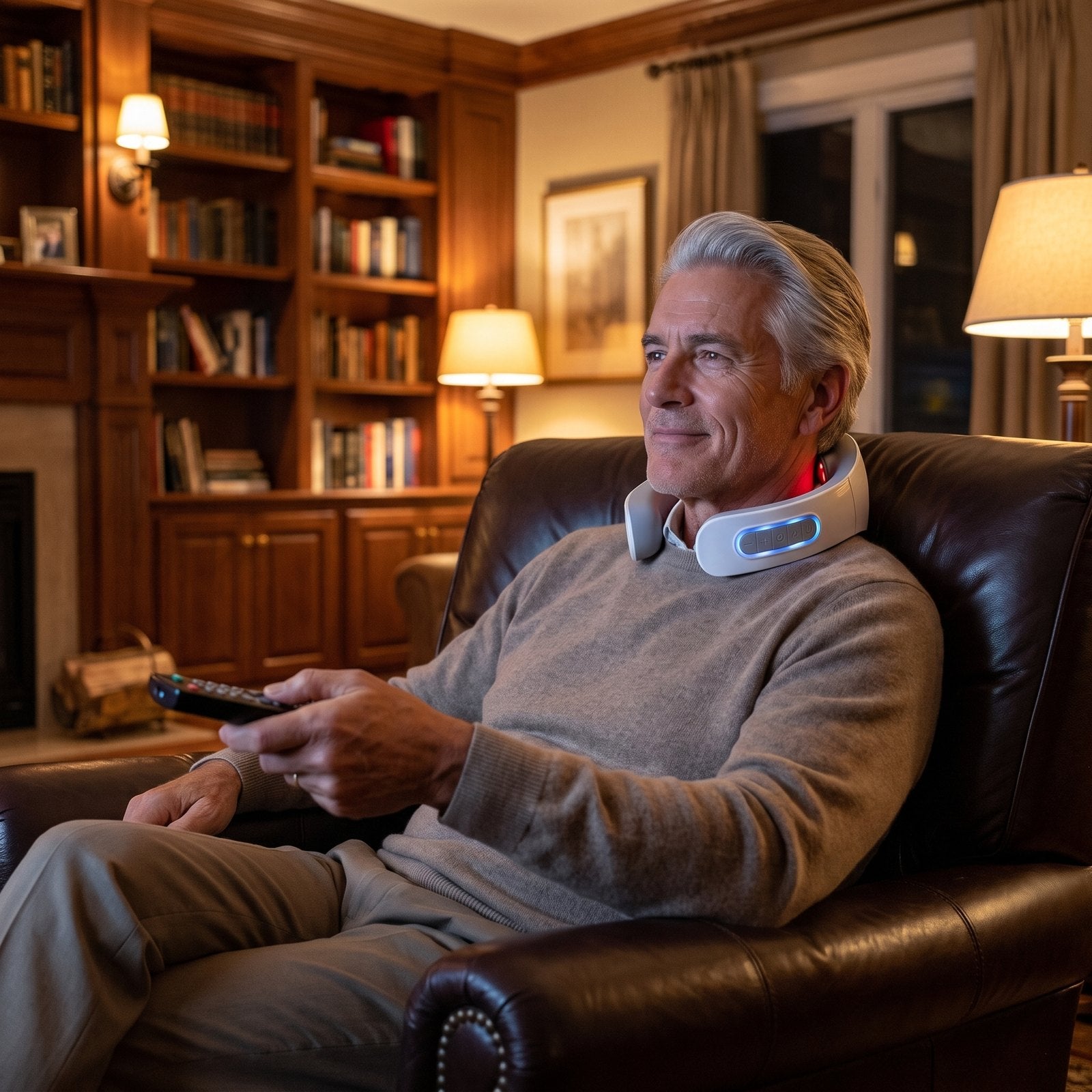
Man relaxing at home wearing the Dr. Nape collar

Is Dr. Nape Backed by Science? What the Research on EMS, Heat and Neck Tension Says

How modern screen habits load the back of your neck, what decades of studies on electrical stimulation and heat have found — and what they haven't.

View the Evidence →

Calling All Researchers

Dr. Nape hasn't been studied in its own trial yet. If you research neck tension, EMS or heat, we'd like to talk.

Interested in contributing to science?

Join our volunteer list and get invited to take part in future Dr. Nape user studies.

Sign up and be part of future research.

Sign up →

When a Tight Neck Becomes Your Normal

Neck pain is one of the most common musculoskeletal complaints in the world: it affected about 203 million people in 2020, and the number is projected to reach 269 million by 2050.1 It is most common between ages 45 and 74.1

The screen-time load

The further your head tilts forward, the more load the neck has to carry. A modelling study estimated the load rising from about 10–12 lb in a neutral posture to around 60 lb at a 60° tilt — the angle many people hold while reading a phone.3

A 2025 meta-analysis of 7 studies (10,715 people) found smartphone overuse was linked to 2.34× higher odds of neck pain.2

Why pulse + heat

Electrical stimulation (TENS and its close relative EMS) sends small pulses through pads on the skin. It is one of the most studied drug-free options for muscle and joint discomfort.4

Heat increases blood flow, metabolism and the elasticity of connective tissue.6 Dr. Nape puts both in one collar that sits at the back of your neck.

Electrical stimulation: one of the most researched drug-free options

Transcutaneous electrical nerve stimulation (TENS) has been tested in hundreds of randomized controlled trials. The largest review to date pooled 381 of them.4 Most of this research uses TENS settings rather than EMS, and none of it tested Dr. Nape itself.

203Mpeople with neck pain worldwide, 20201
269Mprojected by 20501
2.34×higher odds of neck pain with smartphone overuse2
381randomized trials of TENS in the largest review4
—Dr. Nape sessions logged

Scientific evidence

What published research has measured so far — aims, methods and results, in plain English.

BMJ Open · 2022
381randomized trials · 24,532 people
Systematic review & meta-analysis
Independent research

Efficacy and safety of transcutaneous electrical nerve stimulation (TENS) for acute and chronic pain in adults: the meta-TENS study

Aim: To investigate how well TENS relieves pain in adults, and how safe it is, across every diagnosis studied.

Key takeaways

  • Pain intensity was lower during or right after TENS than with placebo (91 trials, 4,841 people) — rated moderate-certainty evidence.
  • The effect held regardless of whether pain was acute or chronic, or what caused it.
  • Side effects were poorly reported but generally mild, and no different from comparison treatments.
  • Many trials were small, so the exact size of the effect is uncertain.
Read Study →
Am J Phys Med Rehabil · 2016
105people with upper-trapezius trigger points
Single-blind randomized controlled trial
Independent research

TENS vs interferential therapy on the upper trapezius in myofascial pain syndrome

Aim: To compare TENS and interferential therapy, each added to standard care (hot pack, myofascial release and exercise), for trigger points in the muscle between the neck and shoulder.

Key takeaways

  • Eight sessions over 4 weeks.
  • The TENS group showed the biggest immediate and short-term improvements in pain and neck range of motion (P < 0.05).
  • Standard care in every group already included a hot pack — pulse and heat were used together.
Read Study →
Postgraduate Medicine · 2015
Heatvs cold for muscle and joint discomfort
Literature review
Independent research

Mechanisms and efficacy of heat and cold therapies for musculoskeletal injury

Aim: To explain what heat and cold actually do in the body, and how strong the evidence is for each.

Key takeaways

  • Heat relieves pain and increases blood flow, metabolism and the elasticity of connective tissue.
  • Randomized trials show heat-wrap therapy gives short-term pain relief in acute low back pain, and more relief than cold for next-day muscle soreness.
  • Overall evidence for topical heat is still limited; more high-quality trials are needed.
Read Study →
Cochrane Database Syst Rev · 2013
20small trials · 1,239 people with neck pain
Cochrane systematic review
Independent research · mixed results

Electrotherapy for neck pain

Aim: To assess short-, medium- and long-term effects of electrotherapy used on its own for adults with neck pain.

Key takeaways

  • Trials were small, of varied quality and could not be pooled.
  • TENS showed inconsistent results for neck pain.
  • Electric muscle stimulation (EMS) was not shown to be more effective than placebo — very low-quality evidence.
  • The authors could not make firm statements on electrotherapy for neck pain; better trials are needed.
Read Study →
Science by Dr. Nape
—no Dr. Nape study yet
STUDY SLOT
Science by Dr. Nape

Want to run it with us? Collaborate with us →

What the research does — and doesn't — say

  • Most studies test TENS. EMS uses similar pulses at different settings, but results for one don't automatically apply to the other.
  • Evidence specifically for neck pain is limited and mixed; the Cochrane review did not find EMS better than placebo.7
  • No study has tested the Dr. Nape collar itself.
  • Dr. Nape is a general wellness massager for relaxing tight muscles. It is not a medical device and does not diagnose, treat or cure any condition.

Calling All Researchers

Let's collaborate to drive meaningful progress. Reach out to explore a study together.

References

  1. GBD 2021 Neck Pain Collaborators. Global, regional, and national burden of neck pain, 1990–2020, and projections to 2050: a systematic analysis of the Global Burden of Disease Study 2021. Lancet Rheumatol. 2024;6(3):e142–e155. doi:10.1016/S2665-9913(23)00321-1. pubmed.ncbi.nlm.nih.gov/38383088
  2. Chen YJ, Hu CY, Wu WT, et al. Association of smartphone overuse and neck pain: a systematic review and meta-analysis. Postgrad Med J. 2025;101(1197):620–626. doi:10.1093/postmj/qgae200. pubmed.ncbi.nlm.nih.gov/39764644
  3. Hansraj KK. Assessment of stresses in the cervical spine caused by posture and position of the head. Surg Technol Int. 2014;25:277–279. pubmed.ncbi.nlm.nih.gov/25393825
  4. Johnson MI, Paley CA, Jones G, Mulvey MR, Wittkopf PG. Efficacy and safety of transcutaneous electrical nerve stimulation (TENS) for acute and chronic pain in adults: a systematic review and meta-analysis of 381 studies (the meta-TENS study). BMJ Open. 2022;12(2):e051073. doi:10.1136/bmjopen-2021-051073. pubmed.ncbi.nlm.nih.gov/35144946
  5. Dissanayaka TD, Pallegama RW, Suraweera HJ, Johnson MI, Kariyawasam AP. Comparison of the effectiveness of transcutaneous electrical nerve stimulation and interferential therapy on the upper trapezius in myofascial pain syndrome: a randomized controlled study. Am J Phys Med Rehabil. 2016;95(9):663–672. doi:10.1097/PHM.0000000000000461. pubmed.ncbi.nlm.nih.gov/26945216
  6. Malanga GA, Yan N, Stark J. Mechanisms and efficacy of heat and cold therapies for musculoskeletal injury. Postgrad Med. 2015;127(1):57–65. doi:10.1080/00325481.2015.992719. pubmed.ncbi.nlm.nih.gov/25526231
  7. Kroeling P, Gross A, Graham N, et al. Electrotherapy for neck pain. Cochrane Database Syst Rev. 2013;(8):CD004251. doi:10.1002/14651858.CD004251.pub5. pubmed.ncbi.nlm.nih.gov/23979926

Dr. Nape is a general wellness product intended to relax tight muscles and ease everyday tension. It is not a medical device and is not intended to diagnose, treat, cure, or prevent any disease. The research above covers TENS/EMS-class stimulation and heat in general, not the Dr. Nape device. Individual results vary.